
Estimated reading time: 10 minutes
This guide shows you exactly why homework blows up at home. And the simple, brain-calming steps that make it doable tonight.
If evenings end in tears (yours or theirs), you’re not alone. When parents ask, “Why is homework hard?”, the real reason is usually a dysregulated nervous system.
When the brain is stressed, executive skills—focus, planning, memory—go offline. Calm the brain first, and everything gets easier. Regulate → Connect → Correct.™
That’s why I always start with the brain. When we calm the nervous system first, kids can think, learn, and connect again.
In this article, you’ll get: quick regulation tools, ADHD-friendly structures, teacher scripts, and a simple nightly plan that stops the power struggles.
Why Kids Melt Down Even When They Understand Homework
Homework is a stress test on the brain. When stress rises, kids look avoidant, oppositional, or “lazy.” What you’re seeing is dysregulation, not defiance. Behavior is communication.
Likely roots (often layered):
- Anxiety/perfectionism → avoidance, stomachaches, tears (Li & Ding, 2024).
- Executive function gaps → trouble starting, organizing, remembering steps (Center on the Developing Child, 2014).
- Overload or unclear directions → overwhelm and shutdown (Cooper et al., 2006).
Parent story—Myrna (10, anxiety):
She studied for hours but froze at the blank page. We regulated first (slow 4-6 breathing + shoulder squeezes), then chunked the paragraph into three sticky-note lines. Her brain re-engaged.
Takeaway:
Calm → Clarity → Action.
“Executive function and self-regulation skills provide critical support for learning.” — Center on the Developing Child (2014).
Is It Low Motivation—Or a Dysregulated Brain?
Kids don’t choose struggle. It’s not bad parenting—it’s a dysregulated brain.
A calm nervous system can want to do work. A dysregulated one can’t—even with rewards.
Look for state, not “willpower”:
- Under-aroused: zoning out, “I’m tired.”
- Over-aroused: irritability, rushing, big emotions.
- Mismatch: task is too hard/boring → the brain taps out.
Fix the state first (fast reset):
- 60–120 seconds of movement (wall pushes, chair squats).
- Co-regulation: your slow exhale; your calm voice.
- Tiny start: one sentence, five problems, or one vocab card.
Why this works:
Regulating the nervous system turns on executive skills (Center on the Developing Child, 2014).
How to Calm Homework Anxiety Fast
Anxiety often shows up as procrastination or perfectionism. We can coach the brain back to calm.
3-minute reset
- Breathe: In 4, out 6, x10.
- Ground: “Name 5 things you see, 4 feel, 3 hear.”
- Simplify: “First, this tiny step.”
- Normalize: “Your brain is sounding an alarm. We can calm it.”
Parent story—Lina (8, “immature”):
Lina ping-ponged between snacks and tears after school. We added a 10-minute movement-then-calm routine and a picture schedule. Fewer tears; faster starts.
Takeaway:
Predictability lowers anxiety (Li & Ding, 2024).
“When parental structure increases, homework anxiety decreases through better motivation.” — Li & Ding (2024).
How ADHD Disrupts Executive Functioning (and Why Homework Feels So Hard)
ADHD is an executive function condition. Homework demands planning, working memory, and sustained attention—exactly the skills ADHD challenges.
ADHD-Friendly Structures
- Micro-chunk + micro-reward every 5–10 minutes.
- Externalize everything: whiteboard steps, checklist, visible timer.
- Move before work: primes attention systems.
- Home–school homework plan: simple, consistent routines reduce conflict and boost completion (Power, Karustis, & Habboushe, 2001).
“Homework for young students should be short and lead to success without much struggle.” — Harris Cooper, PhD (2006).
Parent story—Reymart (12, ADHD):
We set a 15-minute math sprint, 3-minute break, repeat ×3. Visual timer, checklist, quick praise. His “two-hour” math block became 45 focused minutes. Takeaway: structure beats nagging.

How to Procrastination and Time Blindness?
If your child always starts “later,” they may be time blind—a common EF issue. The fix is visible time and tiny entries.
Turn the Crank
- 2-Minute Entry: open the doc and type the title.
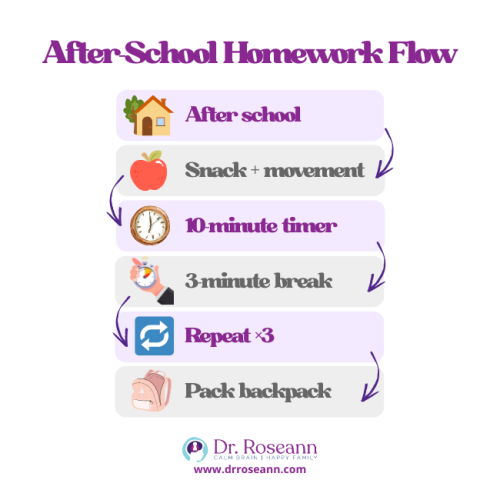
- Time-boxing: 10 minutes on / 3 minutes off (timer visible).
- First–Then: “First five vocab cards, then”
- Done Bin: a place where finished work goes to make wins visible.
Short, simple chunks help the brain feel safe and focused (Center on the Developing Child, 2014).
What to Do and Say Tonight?
Your calm is the lever. You can’t teach a dysregulated brain. Let’s Regulate. Connect. Correct.™
Say this (keep it simple)
- Regulate: “Let’s breathe together; squeeze my hands.”
- Connect: “Homework feels big tonight. I get it.”
- Correct: “Let’s do the first sentence. I’ll set a 10-minute timer.”
Parent checklist
- Bold the wins (You stuck with it for 10 minutes—great grit.)
- Concrete tasks (numbers, not vibes).
- Planned breaks up front.
- Email the teacher early if directions are unclear.
EF skills are built through practice + scaffolds, not lectures — Center on the Developing Child (2014).
Remember, behavior is communication. Calm first, and cooperation follows
When to Bring the School Team Into the Conversation
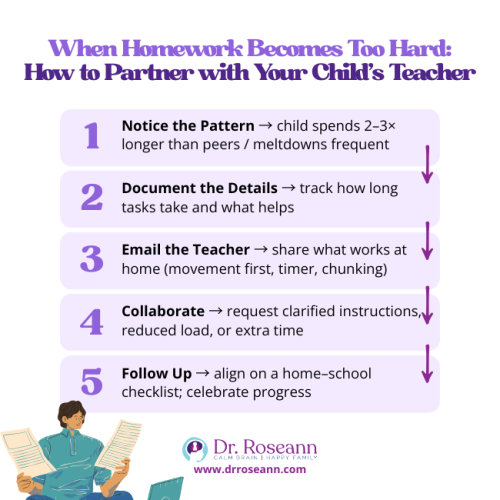
If homework regularly takes 2–3× the expected time, directions are unclear, or meltdowns are frequent, it’s time to partner. Research shows homework benefits are modest and vary by age; more isn’t always better (Cooper et al., 2006).
Email Template Points
- Share what works at home (movement first, chunking, timer).
- Ask for clarified instructions and estimated time.
- Request reduced load or extended time during flare-ups.
- Align on a home–school checklist (Power et al., 2001).
How to Build Homework Habits That Actually Stick?
Sustainable routines beat heroic nights. Need-supportive structure lowers homework stress and improves motivation (Li & Ding, 2024).
Make It Stick
- Same time, same place, with movement first.
- Light fuel: protein + water before starting.
- Tools ready: whiteboard, timer, done bin.
- Weekly preview: look ahead; schedule “hard first.”
Homework Fixes at a Glance
| Barrier | What It Looks Like | Regulation-First Fix |
|---|---|---|
| Anxiety/perfectionism | Avoids starting, tears | Breathe 4–6, tiny “first step”, normalize feelings |
| Time blindness | “I’ll do it later”, misses deadlines | Visible timer, 10/3 time boxes, First–Then language |
| Working memory overload | Forgets steps, loses place | Checklist on whiteboard, chunking, Done Bin |
| ADHD restlessness | Up/down, fidgety, distractible | 2–3 min movement, short sprints, micro-rewards |
| Unclear directions | “I don’t get it” spiral | Model one example, email for clarity |
| Overload/too much work | Hours of struggle | Ask for reduced load/ET, prioritize must-dos |
Parent story—Sam (14, ASD + anxiety):
Sam froze on multi-step algebra. We wrote each micro-step on the whiteboard and used a First–Then plan with 10/3 time boxes. Less fight, more finish.
Takeaway:
Externalize steps; shrink the mountain.
Finding Hope (and Calm) When Homework Feels Impossible
If homework time has become the hardest part of your day, take a breath—you’re not failing. And your child isn’t lazy.
What you’re seeing is a stressed, dysregulated brain that needs safety before it can learn. When we calm the brain first, everything—focus, motivation, and confidence—begins to click into place.
Start small tonight. Try the 3-minute Regulate-Connect-Correct™ routine before diving into assignments.
Celebrate tiny wins, and reach out to the teacher when expectations feel off. Each calm moment you create helps your child build the skills they need for life—not just for school.
I know those nights when you feel worn out and worried. Take heart—it won’t always be this hard. Small calm moments lead to big changes.
So, the next time you wonder why is homework hard, remember: it’s not about effort, it’s about regulation. Once the brain feels calm, learning follows.
You’ve got this—and together, we can make homework a moment of growth, not struggle.
Read more about: The Neurodivergent Umbrella: A Guide to Understanding and Supporting Neurodiverse Kids
FAQs
How much homework is “too much”?
If it takes 2–3× the teacher’s estimate or triggers regular meltdowns, it’s too much for your child. Ask for adjusted load and clearer directions (Cooper et al., 2006).
My child says, “I don’t care.” What do I do?
Hear the feeling, not the words: “School feels heavy. Let’s do a 10-minute start together.” Normalize, then chunk.
Should I sit next to my child the whole time?
Co-regulate at the start, then fade to check-ins every 10–15 minutes. Aim for independence, not isolation (Power et al., 2001).
What if my child refuses to start?
Use a 2-minute entry task (open doc, write title), set a timer, pair it with movement before and a tiny reward after. Repeatable beats perfect.
Terminology
- Dysregulation: The nervous system is over- or under-activated, so thinking and coping skills go offline.
- Executive Function (EF): Brain skills for planning, focus, memory, and self-control.
- Time Blindness: Difficulty sensing how long tasks take or when to start/stop.
- Co-regulation: Your calm nervous system helps your child settle.
Citations
Center on the Developing Child at Harvard University. (2014). Enhancing and practicing executive function skills with children from infancy to adolescence (Working Paper). Harvard University. https://developingchild.harvard.edu/resources/activities-guide-enhancing-and-practicing-executive-function-skills/
Cooper, H., Robinson, J. C., & Patall, E. A. (2006). Does homework improve academic achievement? A synthesis of research, 1987–2003. Review of Educational Research, 76(1), 1–62. https://doi.org/10.3102/00346543076001001
Li, J., & Ding, Y. (2024). Influence of parental structure and chaos on homework anxiety in elementary school students: The mediating role of homework motivation. Frontiers in Psychology, 15, 1399507. https://www.frontiersin.org/articles/10.3389/fpsyg.2024.1399507/full
Always remember… “Calm Brain, Happy Family™”
Disclaimer: This article is not intended to give health advice, and it is recommended to consult with a physician before beginning any new wellness regimen. The effectiveness of diagnosis and treatment varies from patient to patient and condition to condition. Dr. Roseann Capanna-Hodge, LLC, does not guarantee specific results.
Are you looking for SOLUTIONS for your struggling child or teen?
Dr. Roseann and her team are all about science-backed solutions, so you are in the right place!
©Roseann Capanna-Hodge