
Estimated reading time: 6 minutes
When constant notifications, stress, or multitasking pull your attention away, your child’s nervous system feels it.
This guide unpacks what distracted parenting really means, why it matters for your child’s developing brain, and how small, mindful shifts can restore calm and connection at home
What Is Distracted Parenting and Why It Matters
Distracted parenting happens when our attention is split by phones, work, or stress. It’s not bad parenting—it’s the result of modern overload and a dysregulated nervous system.
When we’re overwhelmed, the brain shifts into survival mode, making presence hard. Kids feel that absence as disconnection or rejection.
What’s happening:
- Stress or screen use pulls us from real connection
- Children sense distraction as emotional unavailability (Chamam, 2024)
Why it matters:
- Presence builds safety and regulation
- Repeated disconnection fuels anxiety or acting out
How to reconnect:
- Create phone-free moments
- Breathe, ground, then engage
- Repair when you drift away
Even small, intentional moments tell your child, “I’m here, I see you, you matter.”
How Distracted Parenting Affect a Child’s Brain and Behavior
The developing brain depends on consistent cues of safety and connection. When parents are mentally elsewhere—even briefly—a child’s nervous system can register this as uncertainty (Zimmer-Gembeck & Skinner, 2021).
Here’s what that can look like:
- Emotional dysregulation (quick frustration, clinginess, or shutdowns)
- Attention problems and poor focus
- Heightened anxiety or irritability
- Sleep or eating issues
- Social withdrawal
Children interpret distraction as, “Something’s wrong. I’m not safe.” Over time, this stress wiring becomes a habit—shaping mood, focus, and resilience.
The good news? The brain can rewire with connection and calm. When we calm the brain first, everything else follows.
Read about: Why Parent and Child Communication Breaks Down
Why Are Parents So Distracted Today?
It’s not lack of love—it’s life overload. Parents today are juggling digital demands, economic stress, and constant alerts. Our attention spans are under siege (Fields et al., 2021).
Top causes of distracted parenting:
| Digital distraction | phones, emails, and social media compete for presence |
| Work-from-home blending | no true “off switch” for attention |
| Mental overload | multitasking drains focus and patience |
| Unresolved stress | a dysregulated parent nervous system |
“We live in an era of continuous partial attention,” notes psychologist Linda Stone.
“It creates the illusion of productivity while eroding presence.”
Parent Story:
Alana, a mom of a 9-year-old with anxiety, noticed her son’s meltdowns spiked whenever she scrolled through work emails at night. When she began putting her phone away after dinner, his bedtime anxiety faded within weeks.
Even ten minutes of undivided presence tells a child, “You’re safe. I’m here.” Because when we calm the brain first, everything else follows.

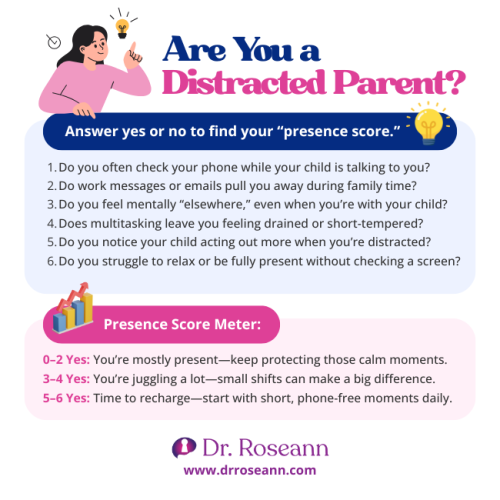
Signs You Might Be a Distracted Parent
You might be practicing distracted parenting if you often:
- Nod without really listening
- Check your phone mid-conversation
- Miss emotional cues (“Mom, you’re not looking at me”)
- React irritably or feel constantly behind
- Feel guilty about “never being fully present”
Quick self-check:
Ask yourself, “When was the last time I gave my child five minutes of full attention—with no device, no agenda?”
How Distracted Parenting Impacts Emotional Regulation
Children learn to regulate emotions through co-regulation—borrowing calm from their caregivers. When we multitask or carry our own stress, that co-regulation breaks down.
- When a parent is tense → a child mirrors that tension.
- When a parent breathes slowly → a child’s nervous system follows.
- When a parent’s attention wanders → a child feels unseen.
That’s why Regulation First Parenting™ always starts with the adult: Regulate → Connect → Correct™.
You can’t teach calm when your own brain is on fire.
Parent Story:
Jason, a father of twins with ADHD, noticed he snapped more on nights when he worked late. By taking a two-minute breathing reset before greeting them, he saw fewer arguments—and more laughter.
Takeaway:
Even small regulation moments in you spark calm in them.
How Can Parents Stay More Present and Regulated?
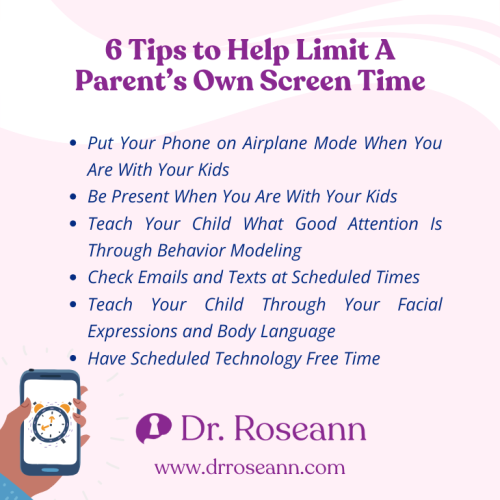
Presence is a skill—and it starts with nervous system care. When you calm your brain first, attention naturally follows. Here are six simple, science-backed ways to reduce screen time and reconnect with your child:
1. Put Your Phone on Airplane Mode During Family Time
- You don’t need to be available 24/7. Silence notifications and put your phone away during meals or play.
- Your child only gets one version of you—make it the fully present one.
2. Create No-Phone Zones and Routines
- Boundaries create safety and connection.
- Try device-free zones
- dinner table
- bedtime
- school pickup
- Model it out loud. “My phone rests while we eat.” Kids learn limits by watching you set them.
3. Check Messages at Set Times
- Designate email or text windows (9 a.m., 1 p.m., and 4 p.m) and stick to them.
- Auto-replies free you from guilt and show your child what healthy digital discipline looks like.
4. Build Small Moments of Real Connection
- Five minutes of child-led time—eye contact, laughter, or a story—regulates both nervous systems.
- These micro-moments matter more than hours of distracted presence.
5. Model Mindful Attention
- Kids mirror what they see.
- When you stay focused on one thing at a time, you’re teaching self-regulation, patience, and follow-through—skills they’ll need for life.
6. Reset Your Nervous System Daily
- Calm your own body before connecting. Try:
- deep breathing
- stretching
- gentle walks
- CALM PEMF™
- A regulated parent sets the tone for a regulated child.
Even short, phone-free moments tell your child, “You matter more than my screen.” Because when we calm the brain first, everything else follows.
Can Technology Ever Help With Connection?
Yes—when it’s used intentionally. Technology isn’t the enemy; disconnection is.
Use tech to co-engage, not escape:
- Watch or create together (build playlists, learn something side-by-side)
- Send positive voice notes during the day
- Use reminders for “presence breaks” instead of endless scrolls
Connection—not perfection—is what calms the brain
What If You’ve Been Distracted for a While? Is It Too Late to Reconnect?
Never. Brains don’t work like concrete—they’re clay. Soft. Moldable. Plastic. Connection can reshape old wiring, one small moment at a time.
Start small.
- Offer one moment of repair. “I’m sorry I wasn’t really listening earlier.”
- Schedule daily check-ins. “What made you smile today?”
- Rebuild trust through routine predictability.
Parent Story:
Elena, mom of a 12-year-old with ADHD, started a nightly ritual—five minutes of “no-tech talk” before bed. Within a month, her son’s defiance softened into conversation.
Takeaway:
Consistency heals faster than perfection.
Parent Action Steps
FAQs
Is distracted parenting the same as neglect?
No. Distracted parenting comes from overwhelm, not indifference. You can always restore connection by slowing down and showing up fully.
How much screen time is too much for parents?
If phones interrupt meals, eye contact, or conversations, it’s too much. Keep device use intentional and limited to set times.
Can kids bounce back from distracted parenting?
Absolutely. Consistent repair and mindful presence rebuild trust faster than you think. Kids respond quickly when they feel seen again.
How do I manage my phone habits?
Try app timers, airplane mode during family time, and one phone-free day each week. Boundaries protect connection.
Does distracted parenting affect teens differently?
Yes. Teens appear independent but still need emotional safety. They pull away when parents seem unavailable—presence matters even more now.
Citations
Chamam, S., Forcella, A., Musio, N., Quinodoz, F., & Dimitrova, N. (2024). Effects of digital and non-digital parental distraction on parent-child interaction and communication. Frontiers in child and adolescent psychiatry, 3, 1330331. https://doi.org/10.3389/frcha.2024.1330331
Fields, A., Harmon, C., Lee, Z., Louie, J. Y., & Tottenham, N. (2021). Parent’s anxiety links household stress and young children’s behavioral dysregulation. Developmental psychobiology, 63(1), 16–30. https://doi.org/10.1002/dev.22013
Stone, L. (2009, November 30). Beyond simple multi-tasking: Continuous partial attention. Linda Stone [Blog post]. https://lindastone.net/2009/11/30/beyond-simple-multi-tasking-continuous-partial-attention/
Zimmer-Gembeck, M. J., Rudolph, J., Kerin, J., & Bohadana-Brown, G. (2021). Parent emotional regulation: A meta-analytic review of its association with parenting and child adjustment. International Journal of Behavioral Development, 46(1), 63–82. https://doi.org/10.1177/01650254211051086
Dr. Roseann is a mental health expert in Neurodivergence who is frequently in the media:
- Business Insider How to practice ‘autonomy-supported parenting’ to boost your family’s wellbeing
- Healthline Get Stuff Done: A Realistic Guide to Working From Home with Kids
- Different Thinking Different Learning How Low Demand Parenting Can Reduce Stress and Support Neurodivergent Youth with Dr. Roseann Capanna-Hodge
Always remember… “Calm Brain, Happy Family™”
Disclaimer: This article is not intended to give health advice and it is recommended to consult with a physician before beginning any new wellness regime. *The effectiveness of diagnosis and treatment vary by patient and condition. Dr. Roseann Capanna-Hodge, LLC does not guarantee certain results.
Are you looking for SOLUTIONS for your struggling child or teen?
Dr. Roseann and her team are all about science-backed solutions, so you are in the right place!