
Estimated reading time: 8 minutes
If it feels like even simple requests spark panic or shutdowns at your house, this guide will show you why—and what actually helps.
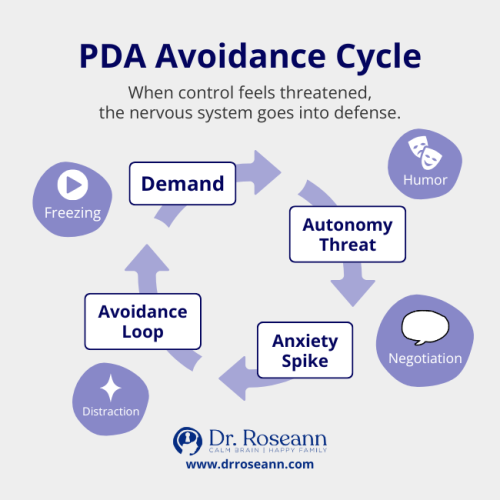
You’re not alone. When a child or young adult has Pathological Demand Avoidance (PDA), even small demands can feel overwhelming. Tasks like brushing teeth, putting on shoes, or applying for a job may feel like threats to autonomy. The result? Avoidance, meltdowns, or total freeze.
In this article, I’ll explain what PDA is, how it overlaps with “failure to launch,” and give you practical, brain-calming tools you can use today. We’ll also talk about school supports, teen/young adult steps, and what to try when nothing else has worked.
What Is PDA—And How Is It Different From “Won’t”?
PDA is a profile often discussed within autism, where a person shows extreme demand avoidance. It’s driven by anxiety and a strong need for autonomy.
The term was introduced by developmental psychologist Elizabeth Newson. She described PDA as an “obsessional avoidance of the ordinary demands of everyday life.”
Key Points Parents Ask About
- PDA is debated and isn’t a formal diagnosis in the DSM right now. Some organizations describe it as a demand-avoidant profile seen in some autistic people.
- Many PDAers use social strategies such as negotiation, distraction, or role-play to avoid demands. They often respond better to autonomy-supportive approaches than to traditional behavior plans.
Is It PDA, ADHD, ODD… or Nervous System Dysregulation?
PDA can look a lot like oppositional defiant disorder (constant arguing or refusals) or ADHD (struggles with focus and follow-through). But here’s the key difference: with PDA, the behaviors are usually driven by anxiety and a strong need for control, not defiance or laziness.
Research shows that kids with PDA traits often have their own unique “demand avoidance” profile and challenges with social communication (O’Nions et al., 2017). In other words, the behavior isn’t random—it’s their nervous system saying, “I feel unsafe.”
Parents also consistently report that these kids need more tailored school supports to succeed (Gore Langton & Frederickson, 2015).
Takeaway:
PDA behaviors aren’t about bad choices—they’re signs of a dysregulated brain needing safety and support.
Signals It’s PDA-like Demand Avoidance
- Panic or shutdown when any request is framed as a demand
- Better participation when choice, novelty, or collaboration increases control
- Traditional sticker charts/consequences backfire (PDA Society notes this, too).
The National Autistic Society emphasizes that there’s limited research and ongoing debate about the label. Supports should be individualized.
Why Do Everyday Demands Trigger Panic or Shutdowns?
When a demand lands like a control-grab, the nervous system hits fight/flight/freeze. That’s why the first step is always: Let’s calm the brain first. Once the nervous system is regulated, connection and problem-solving return.
Parent story: “Sarah” (age 10, anxiety + sensory needs)
Mornings were chaotic until Sarah’s mom switched to low-demand language (“Purple or blue leggings today?”). She added a 2-minute breathing game and used visual choices. Meltdowns dropped, and Julia got to school on time.
Takeaway: Anxiety falls when autonomy rises and the body calms.
Try These “Autonomy + Regulation” Swaps
- Say “How can we…” instead of “You must…”
- Offer 2 choices or time-buffer (“in 5 or 10 minutes?”)
- Use movement (wall push-ups, short walk) before tasks
- Keep requests short + specific; avoid lectures
How Do I Lower Demands Without “Giving In”?
Lowering demand is not permissive—it’s therapeutic when anxiety is the driver. The PDA Society notes that traditional techniques can make things worse for PDAers; autonomy-supportive, low-arousal approaches work better.
Make Demands Feel Safer
- Collaborative framing: “We have a problem—how do we solve it?”
- Invite role-play/imaginary play: Turning tasks into a game reduces threat.
- Co-regulate first: Slow exhale, soft eyes, low voice. Your calm leads their calm.
- Micro-goals: One bite of the task → celebrate → next bite.
- Visual plan: 3-step card: Regulate → Connect → Correct™.
Parent story: “Ben” (age 8, PDA-like profile)
Homework battles stopped when Dad offered two tiny wins (“write name + first sentence”), a timer race, and a choice of topic.
Takeaway: Small wins + choice build momentum.
What if My Teen Is Stuck at Home? (Pda + Failure to Launch)
Some PDAers hit a wall in late adolescence. Executive dysfunction, anxiety, and repeated demand failures can lead to avoidance of adult roles—what families often call “failure to launch.” It isn’t laziness; it’s dysregulation combined with an overwhelming number of demands.
What Helps Young Adults (like “Linda”)
- Regulation tools: Neurofeedback, CALM PEMF®, targeted magnesium, exercise/sleep rhythms—these can support brain balance so other therapies work better (in our BrainBehaviorReset® program, we often combine them).
- Autonomy-first planning: “Choose which two adulting tasks today” (email, laundry, job search step).
- Job-search by micro-steps: Profile photo → resume bullet → 1 application.
- Scaffolded independence: Co-work sessions, shared calendars, body-doubling.
- Language shift: “What gets in the way?” → remove barriers, then try one step.
Parent story: “Linda” (young adult, PDA + low motivation)
Linda froze with most demands. We focused on brain regulation + choice-based goals. Over time, she handled social situations with less panic, slept better, and completed 2–3 adult tasks daily.
Takeaway: Regulate first, then autonomy, then skills—repeat.
Note: “Failure to launch” is a descriptive label, not a diagnosis; it often signals underlying anxiety/skills gaps. (General guidance mirrors this framing across reputable sources.)
What Should Schools Do Differently For A PDA Profile?
Schools can be overwhelming—constant demands, transitions, and sensory load. A low-arousal, collaborative plan makes learning possible.
Parents in UK studies report high support needs for PDA-profile students (Gore Langton & Frederickson, 2015). Practice guidance stresses tailoring supports to a constellation of traits, not a one-size plan.
Ask for These Supports
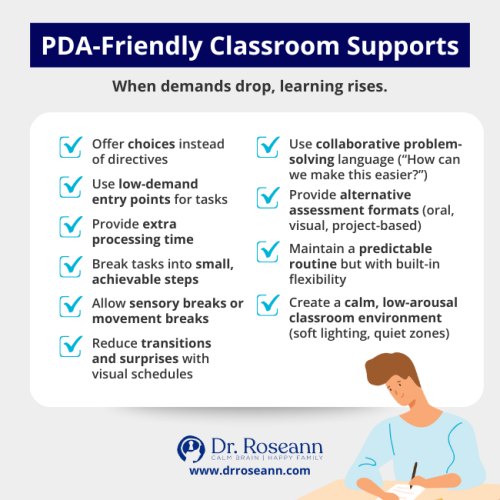
- Low-demand entry to tasks; offer choice and novelty
- Predictable routines with opt-in breaks and sensory regulation
- Assessment flexibility (orals, visuals, chunked work)
- Collaborative scripts (“How could we make this easier?”)
How Do I Start Regulation First Parenting™ Today?
No healing without calm. Our sequence—Regulate → Connect → Correct™—puts nervous system balance ahead of behavior change.
Do this today (10 minutes total)
- Regulate (3 min): 5 slow exhales together + 30 seconds of wall push-ups
- Connect (3 min): Reflect feeling + offer two choices
- Correct (4 min): Co-create one bite-sized step and celebrate completion
“Resistance to demands is… observed in some autistic people.” —National Autistic Society. The point isn’t to crush resistance; it’s to meet the anxiety underneath with safety and flexibility.
You’re Not Failing—You’re Learning to Lead with Calm
Behavior is communication. When we see avoidance as a dysregulated brain protecting itself, everything changes. By responding with regulation, connection, and collaboration, kids and young adults can thrive.
If Pathological Demand Avoidance is part of your family’s story, remember: you have tools, and your child has strengths.
Next Best Step:
- Grab the Low-Demand Language Guide and try two phrases.
- Explore brain-based supports (QEEG/neurofeedback, CALM PEMF®, magnesium, sleep, movement) through our BrainBehaviorReset® framework.
Read more about: Failure to Launch Syndrome: Root Causes, Warning Signs, and Calm-First Solutions
FAQs about Pathological Demand Avoidance (PDA)
Is PDA the same as being oppositional?
No. PDA behaviors are anxiety-driven and tied to autonomy needs, which are different from willful defiance. (O’Nions et al., 2017)
Can non-autistic kids have PDA traits?
Demand avoidance is most discussed within autism, but profiles can vary. Focus on what calms your child’s nervous system and what supports reduce threat.
Do consequences and rewards work?
Often not. PDAers may escalate with traditional behavior plans; low-demand, collaborative strategies and co-regulation usually work better.
What language helps most?
Choice-rich, time-buffered, collaborative language (“Would you like to start in 5 or 10 minutes?”) reduces threat and boosts follow-through.
Terminology
- Pathological Demand Avoidance (PDA): An anxiety-driven profile marked by extreme avoidance of everyday demands and a strong need for autonomy.
- Low-demand approach: Language and routines that reduce threat and increase choice.
- Co-regulation: Your calm body and voice help your child’s nervous system calm down.
- Executive dysfunction: Trouble planning, starting, and finishing tasks.
Citations
Gore Langton, E., & Frederickson, N. (2015). Mapping the educational experiences of children with pathological demand avoidance. Journal of Research in Special Educational Needs, 16(4), 254–263.
https://doi.org/10.1111/1471-3802.12081
O’Nions, E., Viding, E., Floyd, C., Quinlan, E., Pidgeon, C., Gould, J., & Happé, F. (2017). Dimensions of difficulty in children reported to have an autism spectrum diagnosis and features of extreme/“pathological” demand avoidance. Child and Adolescent Mental Health, 23(3), 220–227.
https://doi.org/10.1111/camh.12242
Trundle, G., Craig, L. A., & Stringer, I. (2017). Differentiating between pathological demand avoidance and antisocial personality disorder: A case study. Journal of Intellectual Disabilities and Offending Behaviour, 8(1), 13–27. https://doi.org/10.1108/JIDOB-07-2016-0013
Always remember… “Calm Brain, Happy Family™”
Disclaimer: This article is not intended to give health advice, and it is recommended to consult with a physician before beginning any new wellness regimen. The effectiveness of diagnosis and treatment varies from patient to patient and condition to condition. Dr. Roseann Capanna-Hodge, LLC, does not guarantee specific results.
Are you looking for SOLUTIONS for your struggling child or teen
Dr. Roseann and her team are all about science-backed solutions, so you are in the right place!
© Roseann Capanna-Hodge