
Estimated reading time: 7 minutes
This is your playbook for spotting parenting bias in everyday moments. And replacing it with calm, connection, and science-backed tools that work.
If your child’s meltdowns or “no!” responses are wearing you out, you’re not alone.
As parents, we all see through invisible lenses. These quiet habits shape what we notice, how we react, and how our kids see themselves. That lens is where parenting bias sneaks in.
In this guide, we’ll look at behavior through the nervous system. You’ll see how negativity bias shows up at home and what to do about it. I’ll show you simple ways to calm first, connect, and then correct—without shame or blame.
What Is Parenting Bias—And How Does It Sneak Into Everyday Comments?
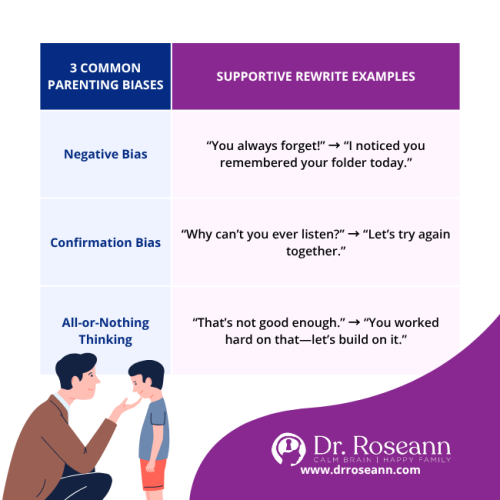
We all have mental shortcuts. In parenting, those shortcuts can sound like: “You always forget your homework,” or “Why can’t you ever listen?”
That is parenting bias—a pattern of focusing on what’s wrong, overgeneralizing, or confirming what we already believe.
What to Watch For:
- Negativity bias: scanning for what went wrong first
- Confirmation bias: noticing only behavior that fits your story (“He’s the ‘difficult’ one”)
- All-or-nothing thinking: “perfect or failure,” with no middle ground
Why this matters:
Biased attention feeds dysregulation. A dysregulated brain can’t learn or comply well. Let’s calm the brain first, then connection and correction can stick. Regulate. Connect. Correct.™
How Negativity Bias Shows up in Families (And Why It Sticks)
Our brains notice threats faster than wins—great for cave life, tough for family life. That “glass-half-empty” scan keeps everyone on edge and cements patterns that don’t serve our kids or us.
Research on negativity bias shows “bad” carries more weight than “good,” so we must actively collect positives (Baumeister et al., 2001).
Try this tonight
- Spot three gains: tiny efforts count (zipped backpack, used words before tears).
- Name them specifically: “I saw you breathe before answering your sister.”
- Link to identity: “That shows grit.”
Parenting bias often hides inside rushed routines. Slow the moment; see the gain.
How Your Words Affect Your Child’s Anxiety and Self-Worth
Words land in the nervous system. Chronic criticism or tense tone fuels anxiety, perfectionism, and shutdown.
Youth pick up on posture and micro-expressions too (Gulley et al., 2014). When we validate feelings and redirect behavior, kids feel safer—and safer brains learn better.
Swap these today:
- From: “Stop overreacting.”
To: “Big feelings. I’m here. Let’s breathe together.” (co-regulation helps kids borrow your calm). - From: “You never listen.”
To: “First, eyes. Then directions. I’ll go slow.”
Parent story—Summer (age 15):
Summer was a bright, anxious perfectionist. Her parents pushed to “help,” but the pressure spiked her worry and shutdowns. Together, we shifted to co-regulation, praised the process, and set consistent routines. The whole family learned to regulate first, then connect and correct. Grades stabilized; drama softened. The win wasn’t perfection. It was a calmer brain and a warmer home.
What Breaks the Cycle Fast When Everyone Is Dysregulated?
When emotions spike, logic goes offline. Your job: share your calm. Here’s a quick reset that respects the brain.
RESET to Regulate (2–5 minutes)
- Pause your body. Unclench jaw, drop shoulders.
- Low, slow voice. Under 70% volume.
- One cue at a time. “Feet on floor.” Then “Hand on heart.”
- Shape breath: in nose 4, out mouth 6 (you model).
- Bridge to action: “When your body is ready, we’ll pack the folder together.”
“You can’t teach in the red zone; connect first, then guide.” — Ross W. Greene, Ph.D.
Short, simple, predictable steps reduce overwhelm and restore choice. Harvard Health notes that naming positives and modeling calm disrupts the negativity loop (and it’s doable on a Tuesday).
How to Reinforce the Positive Without Becoming “Toxic Positivity”
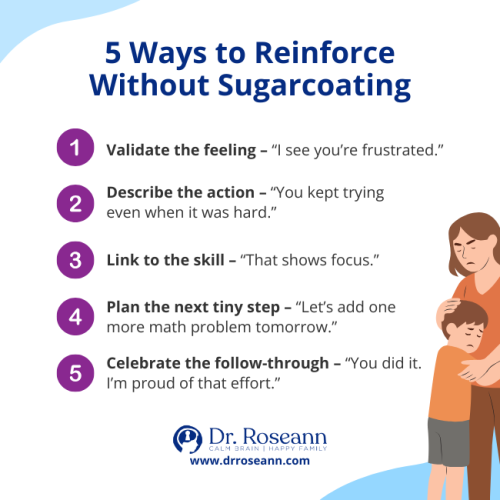
We don’t ignore hard stuff. We name real feelings and notice real gains. That balance rewires attention and builds competence (Sanders et al., 2014).
Make Praise Work Harder
- Be specific: “You used a pause before yelling.”
- Praise effort + strategy: “You tried the breath + squeeze routine.”
- Tie to values: “That was flexible.”
| Situation | Biased Script | Regulate–Connect–Correct Script |
|---|---|---|
| Homework fight | “You’re so lazy.” | “Behavior is communication. Looks stuck. Let’s chunk the first two problems.” |
| Sibling conflict | “You always start it.” | “Both upset. Breathe + reset, then each gets 30 seconds to share.” |
| Morning rush | “You never move!” | “Timer for shoes. I’ll tie one, you tie one. Then breakfast.” |
| Public meltdown | “Stop embarrassing me.” | “I see overwhelm. Hand to heart; my hand on your back. Then we step outside.” |
What It Looks Like In Real Life
- Juliet, mom of a 10-year-old with anxiety
Mornings were battles. We added a visual routine, one sensory break (wall push-ups), and a single-step cue. Julia praised starts, not finishes. Within two weeks, fewer tears and smoother exits. Takeaway: structure + micro-wins calm the brain.
- Miguel, dad of a 7-year-old with ADHD dysregulation
Miguel shifted from “Stop!” to “Do—then praise.” He modeled move–breathe–do (10 jumping jacks, 4–6 breathing, then math). Takeaway: the body is the gateway to focus.
- Ava, caregiver to a teen with OCD
Ava learned to validate the urge without feeding reassurance. “Your brain is sending strong signals; you’re safe. Let’s ride this wave and do our 3-step plan.” Takeaway: Compassionate boundaries build resilience.
“Co-regulation is a supportive, interactive process where caregivers help kids learn better ways to regulate emotions.” — Harvard Health Summary of Lauren Marchette, Ph.D.

Where Parenting Bias Comes From—And How to Change It for Good
Bias often reflects how we were parented and the pace of modern life. Studies show that parents can unintentionally focus on the negative.
Even caring, well-meaning adults can see behavior through their own filters and beliefs. Awareness plus strategy is key.
Make the Shift Stick
- Daily “gain hunt.” Three specifics before bed.
- Co-regulate first. Calm body → calm brain → teach skill.
- Practice scripts. Write two go-to phrases on your phone’s lock screen.
What to Do Next When to Need Extra Support
If you’ve tried everything and still feel stuck, don’t lose hope. There are brain-based tools that can help your child calm, focus, and thrive.
Start with small, steady steps. Try QEEG, neurofeedback, or CALM PEMF® to support brain regulation. Then, add strong daily routines—such as good sleep, protein, movement, and sensory breaks.
Parent coaching can also make a big difference. It helps you use the right scripts and supports for your child’s nervous system needs.
And remember Dr. Dan Siegel’s reminder: “Name it to tame it.” Labeling emotions helps calm the brain and open the door to connection.
Your Next Gentle Step Toward Calmer Parenting
Parenting isn’t easy—and you’re doing better than you think. Every moment you choose calm over criticism, you’re rewiring your child’s brain and healing parenting bias in real time.
When we see behavior as communication and start with nervous system regulation, kids feel safe. And a safe, regulated brain can finally learn, connect, and grow.
Keep going with the small steps. They add up. Calm first, then connect, then correct. Regulate. Connect. Correct.™
You’ve got this. You’re not failing—it’s a dysregulated brain. Let’s calm it first—and your calm changes everything. It’s gonna be OK
FAQs
How do I know if parenting bias is shaping my reactions?
Notice patterns: lots of “always/never,” scanning for mistakes first, or assuming motive (“He’s doing this to push my buttons”). Pause, breathe, and reframe with one neutral observation.
Isn’t focusing on the positives just ignoring real problems?
No. We validate big feelings and address behavior—after we regulate. Balanced reinforcement teaches skills better than criticism (Sanders et al., 2014).
What if my child refuses every tool?
Refusal = dysregulation. Shorten the step. Start with co-regulation (your breath + presence). Offer two choices that both lead forward.
Should I correct in the moment or later?
Suppose a child is red-zoned, correct later. In the moment: regulate + protect safety. After calm returns, teach and practice the skill.
Terminology
- Co-regulation: Your calm helps your child’s brain calm so they can self-regulate next.
- Emotional dysregulation: The brain/body can’t smoothly shift states; feelings get too big or too flat.
- Negativity bias: The brain’s tilt toward spotting what’s wrong first.
- Self-regulation skills: Tools kids use to manage body/brain—breath, movement, sensory input, and scripts.
Citations
Baumeister, R. F., Bratslavsky, E., Finkenauer, C., & Vohs, K. D. (2001). Bad is stronger than good. Review of General Psychology, 5(4), 323–370. https://doi.org/10.1037/1089-2680.5.4.323
Gulley, L. D., Oppenheimer, C. W., & Hankin, B. L. (2014). Associations among negative parenting, attention bias to anger, and social anxiety among youth. Developmental Psychology, 50(2), 577–585. https://doi.org/10.1037/a0033624
Sanders, M. R., Kirby, J. N., Tellegen, C. L., & Day, J. J. (2014). The Triple P-Positive Parenting Program: A systematic review and meta-analysis. Clinical Psychology Review, 34(4), 337–357. https://doi.org/10.1016/j.cpr.2014.04.003
Always remember… “Calm Brain, Happy Family™”
Disclaimer: This article is not intended to give health advice, and it is recommended to consult with a physician before beginning any new wellness regimen. The effectiveness of diagnosis and treatment varies from patient to patient and condition to condition. Dr. Roseann Capanna-Hodge, LLC, does not guarantee specific results.
Are you looking for SOLUTIONS for your struggling child or teen
Dr. Roseann and her team are all about science-backed solutions, so you are in the right place!
© Roseann Capanna-Hodge