
Estimated reading time: 8 minutes
I hear from so many parents who say, “Roseann, I don’t understand. One tiny thing happens, and my child explodes or falls apart for hours.” If we were sitting together right now, I’d look you in the eye and say, “This isn’t you being a “bad parent,” and it isn’t your child being “bad” either. What you’re seeing is an overwhelmed nervous system at work—it’s emotional dysregulation, not defiance.
Emotional regulation is the ability to manage how you feel and express emotions. It’s not about suppressing feelings. It’s about using science-backed emotional regulation techniques to recognize what you’re feeling, understand why, and choose a helpful response instead of reacting in ways that make things worse.
When kids struggle, it shows up everywhere—meltdowns, trouble with friends, or shutting down at school. Behavior is communication. Your child’s nervous system is overwhelmed, and they haven’t yet learned the skills to manage the intensity.
The good news is that emotional regulation is a skill. With the right techniques, your child can learn to calm their brain, pause before reacting, and build resilience. That means fewer meltdowns, stronger relationships, and a child who feels more in control.
I’m Dr. Roseann Capanna-Hodge, and for over three decades, I’ve helped families implement techniques for emotional regulation that work for children with ADHD, anxiety, and other challenges. My science-backed, nervous-system-first approach has helped thousands of parents move from exhaustion to confidence.
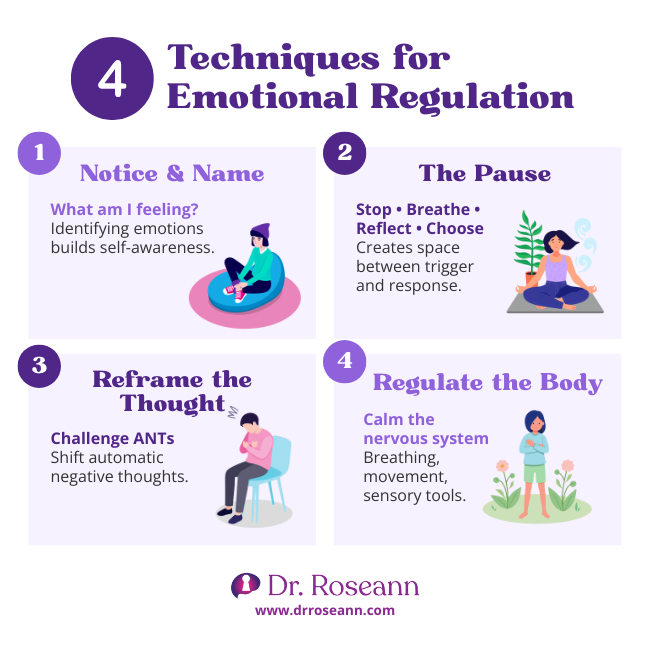
Key emotional regulation techniques include:
- Noticing and naming emotions – Building self-awareness by identifying what you’re feeling.
- The 4-Step Pause – Stop, Breathe, Reflect, Choose to create space between trigger and response.
- Cognitive reframing – Challenging automatic negative thoughts (ANTs).
- Body-based strategies – Using deep breathing, sensory tools, and movement to calm the body.
Emotional regulation is a process that allows us to experience and express our emotions in a balanced way. This ability is crucial for well-being, promoting resilience and mental health (Iwakabe et al., 2023). When we have strong emotional regulation skills, we tend to have healthier behaviors and better overall health. Conversely, difficulties with emotional regulation can lead to high levels of stress and anxiety, contributing to poor physical and mental health.
Practical Emotional Regulation Techniques You Can Use Today
Let’s explore some practical emotional regulation techniques you and your child can start using today to build resilience.
The Foundation: Noticing, Naming, and Accepting Emotions
The first step is to become aware of emotions. Our primary emotions (fear, sorrow, joy, etc.) are biological signals that communicate our needs. Learning to identify and label them is key. Studies show that people who can accurately identify their emotions tend to move through depression faster (Gruffy et al., 2025).
Once you name an emotion, the next step is acceptance. This means acknowledging the emotion is present without judgment. Fighting emotions often makes them stronger. Sometimes, we judge a primary emotion (like sadness) as “bad,” which creates a secondary emotion (like anger). These secondary emotions cause more suffering. By observing and describing our emotions, we can choose how to cope while accepting the feeling as part of our experience.
The 4-Step Pause: A Simple Technique for Emotional Regulation in the Moment
One of the most effective emotional regulation techniques for immediate relief is the “Stop-Breathe-Reflect-Choose” approach. It creates space between a trigger and an impulsive reaction.
- Stop: When a strong emotion arises, simply stop. This interrupts the automatic reaction.
- Breathe: Take a few slow, deep breaths. This activates the calming part of the nervous system and helps calm the brain first.
- Reflect: Once calmer, think about what’s happening. What are you feeling? What triggered it?
- Choose: Instead of reacting, consciously choose a response. This could be communicating your feelings, problem-solving, or taking a longer break.
This technique is invaluable for regaining control when warning signs of strong feelings appear.
Cognitive Reframing: A Powerful Emotional Regulation Technique
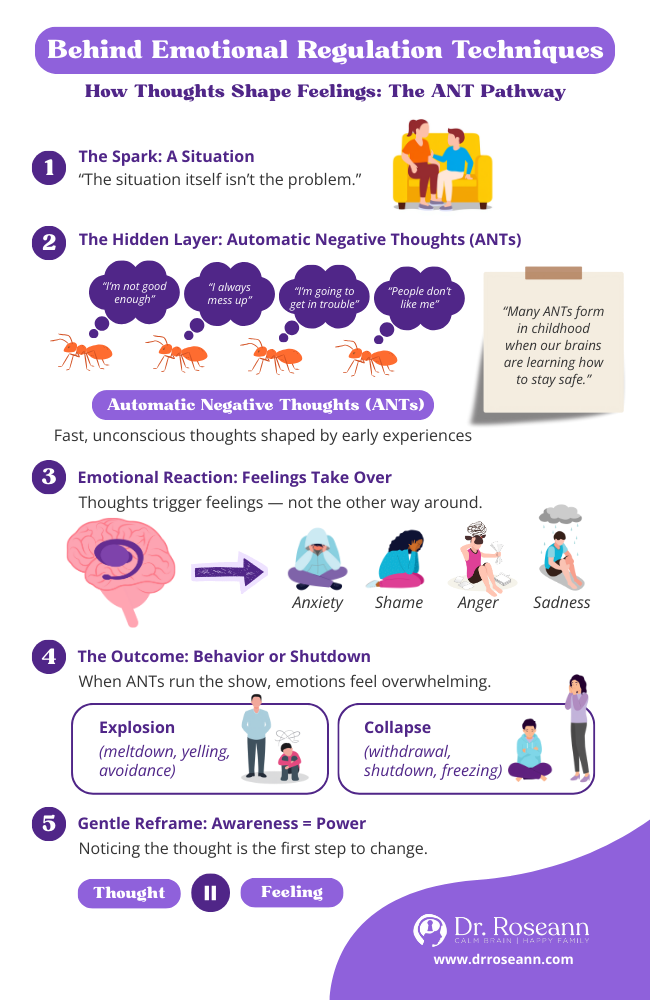
Our thoughts play a huge role in how we feel. Many unpleasant emotions are triggered by Automatic Negative Thoughts (ANTs). These are often unhelpful perceptions we developed as children. The good news is, we can learn to change them!
Cognitive reframing is one of the most powerful emotional regulation techniques because it directly addresses these thought patterns.
- Identify the ANT: Ask, “What thought just went through my mind?” (e.g., “I’m so stupid, I’ll never get this right!”).
- Challenge the thought: Is this thought 100% true? Is there another way to look at this?
- Reframe with positive self-talk: Replace the ANT with a more compassionate thought, like, “This is hard, but I can keep trying.”
- Problem-solve: Shift focus from helplessness to action by asking, “What’s one small step I can take to make this better?”
By consciously choosing how we respond to our thoughts, we can influence our emotions.
Body-Based Emotional Regulation Techniques for Physical Calm
Emotions are deeply intertwined with our bodies. When feelings run high, our nervous system goes into overdrive. Body-based emotional regulation techniques help calm the physical sensations of distress.
Here are some effective body-based techniques:
- Deep Breathing Exercises: Slow, deep breaths signal safety to the brain. Try “belly breathing” or “square breathing” (inhale for 4, hold for 4, exhale for 4, hold for 4).
- Sensory Tools: A weighted blanket, fidget toy, or stress ball can be very grounding and soothe an overstimulated nervous system.
- Physical Activity: Movement releases pent-up emotional energy. Even 20 minutes of daily aerobic exercise can significantly improve emotional regulation.
- Progressive Muscle Relaxation (PMR): This involves tensing and then relaxing different muscle groups to reduce physical stress and promote calm.
Taking care of physical health—sleep, diet, and exercise—is a key prevention basic for emotional well-being. For more custom strategies, you can learn how to support your emotionally dysregulated child.

Understanding the “Why” Behind Emotional Dysregulation
To master emotional regulation techniques, it helps to understand what’s happening in the brain. The amygdala is our brain’s alarm system, triggering the fight-or-flight response. The prefrontal cortex is the “wise leader” that helps us pause and think before reacting. Neuroplasticity research shows we can strengthen this connection to better manage our emotions.
Several factors can lead to emotional dysregulation:
- Automatic Negative Thoughts (ANTs): As discussed, these ingrained thought patterns can trigger a cascade of negative emotions.
- Beliefs about Emotions: Believing certain emotions are “bad” can lead to suppression, which often backfires and causes more volatility.
- Lack of Skills: Sometimes, a child simply hasn’t learned the necessary techniques to cope with intense feelings.
- Stress and Trauma: High-stress environments, trauma, exhaustion, or even hunger can overwhelm the nervous system, making regulation difficult.
The impacts of poor emotion regulation are far-reaching. It can manifest as uncontrolled anger, persistent sadness, or unchecked fear. It often impairs a child’s ability to build healthy relationships and can be seen alongside other mental health challenges like depression, anxiety, or ADHD.
Expanding Your Emotional Regulation Toolkit
Beyond the foundational techniques, other strategies can significantly improve emotional regulation.
Acting on Values for Emotional Agility
Emotional agility, a concept from Susan David, is about being mindful of our emotions, accepting them without judgment, and then choosing a response that aligns with our core values. It’s not about feeling happy all the time, but about facing challenges with courage. When your child learns to act on their values (like kindness) even when feeling frustrated, they build resilience and purpose (Scholz-Kuhn et al., 2023).
Increasing Positive Emotions
While managing difficult emotions is crucial, it’s equally important to cultivate positive ones to build emotional reserves.
- Build Positive Experiences: Encourage enjoyable activities, both short-term (playing a game) and long-term (pursuing a hobby).
- Be Mindful of Positive Experiences: Help your child savor good moments to counteract the brain’s natural “negativity bias.”
- Be Un-Mindful of Worries: While savoring the positive, gently redirect attention away from anxieties.
Even imagining a pleasant activity can improve mood.
The Role of Therapy and DBT in Emotional Regulation
Sometimes, professional support is needed. An emotional regulation disorder describes a condition where someone consistently struggles to manage feelings, leading to significant challenges in daily life. It often co-occurs with ADHD, depression, or anxiety.
Dialectical Behavior Therapy (DBT) is a highly effective therapy designed for severe emotional dysregulation. DBT focuses on identifying negative thinking patterns and replacing them with positive behavioral changes (Normann-Nott et al., 2025 ; de Andrade et al., 2024).
A key component of DBT is building distress tolerance—the ability to sit with uncomfortable emotions without resorting to destructive behaviors. While emotion regulation is about day-to-day management to prevent crises, distress tolerance is about surviving high-stress moments without falling apart. Both are crucial for emotional well-being.
Citations
de Andrade, D., Davidson, L., Robertson, C., Williams, P., Leung, J., Walter, Z., Allan, J., and Hides, L. (2024). Randomized effectiveness-implementation trial of dialectical behavior therapy interventions for young people with borderline personality disorder symptoms. J Clin Psychol, 80(10):2117-2133. https://doi.org/10.1002/jclp.23725.
Gruffy, A., Moka, A., & Daches, S. (2025). The association between depressive symptoms and emotional recovery after failure: Considering the role of emotional clarity. Journal of Affective Disorders, 388: 119539. https://doi.org/10.1016/j.jad.2025.119539
Iwakabe, S., Nakamura, K., Thoma, NC. (2023). Enhancing emotion regulation. Psychother Res., 33(7):918-945. https://doi.org/10.1080/10503307.2023.2183155.
Norman-Nott, N., Briggs, NE., Hesam-Shariati, N., Wilks, C., Schroeder, J., Diwan, A., Suh, J., Newby, J., Newton-JOhn, T., Quide, Y., McAuley, J., and Gustin, S. (2025). Online dialectical behavioral therapy for emotion dysregulation in people with chronic pain: a randomized clinical trial. JAMA Netw Open, 8(5):e256908. https://doi.org/10.1001/jamanetworkopen.2025.6908
Scholz-Kuhn, R., Makarova, E., Bardi, A., & Döring, A. K. (2023). The relationship between young children’s personal values and their teacher-rated behaviors in the classroom. Frontiers in Education, 8(1162335). https://doi.org/10.3389/feduc.2023.1162335
Always remember… “Calm Brain, Happy Family™”
Disclaimer: This article is not intended to give health advice and it is recommended to consult with a physician before beginning any new wellness regime. *The effectiveness of diagnosis and treatment vary by patient and condition. Dr. Roseann Capanna-Hodge, LLC does not guarantee certain results.
Are you looking for SOLUTIONS for your struggling child or teen?
Dr. Roseann and her team are all about science-backed solutions, so you are in the right place!