
Estimated reading time: 7 minutes
Ever feel like your child’s emotions switch faster than a weather app? One minute sunshine. The next? Storm clouds. You’re not alone.
Every parent rides that same wild wave at some point. Mindful parenting doesn’t mean flawless days or endless patience. It means showing up, breathing through chaos, and staying present when everything screams “run!”.
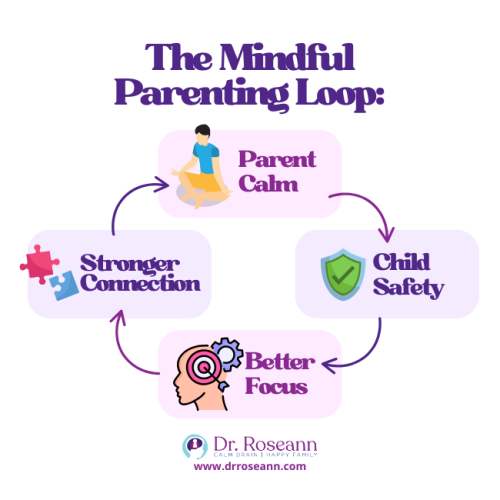
Here’s the twist most parents miss: when you calm your own brain first, your child’s nervous system follows like a mirror catching sunlight. Their body feels safe, their brain opens for connection, and suddenly that wall between you softens.
And when we calm the brain first, everything follows.
What Is Mindful Parenting and Why Does It Matter?
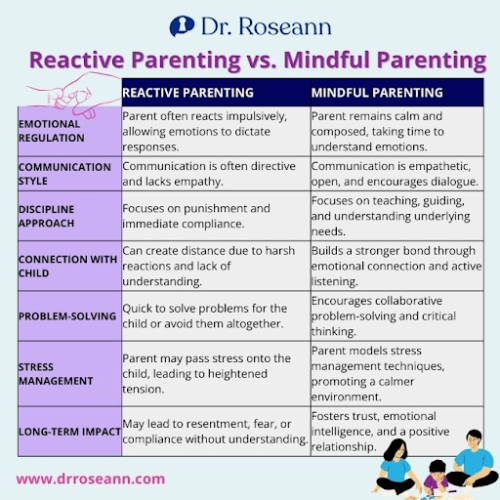
Mindful parenting means bringing calm awareness to how you respond when your child struggles especially in tense moments. It’s not about being perfect—but about practicing presence instead of control.
- When you parent from a regulated space your child’s nervous system mirrors that stillness and the brain can open and learn (Townshend & Caltabiano, 2019).
- In short: calm brains learn; stressed brains react.
By calming your own system first you unlock connection, growth, and peace in your home.
How Does Mindful Parenting Help a Child’s Brain?
Mindful parenting helps shift both you and your child from survival mode into calm focus. When stress takes over, kids yell or shut down—but mindful breathing and co-regulation activate the body’s calm system instead (Bornstein et al., 2023).
Try this:
- Breathe slowly before reacting
- Soften your eyes and shoulders
- Connect before correcting
By calming your own nervous system first, you send powerful safety signals that tell your child’s brain, “You’re safe.” That’s when learning, connection, and cooperation begin to grow.
Core Principles of Mindful Parenting
At its heart, mindful parenting follows my Regulation First Parenting™ framework: Regulate → Connect → Correct™.
When your nervous system is calm, connection happens naturally. And once connection is restored, correction—teaching, guiding, problem-solving—actually works.
Core Mindful Principles:
Awareness | Notice your emotions before reacting. |
Presence | Offer your child undivided attention during key moments. |
Compassion | Remember—behavior is communication, not defiance. |
Non-judgment | See meltdowns as signals, not failures. |
When we calm the brain first, everything else—connection, cooperation, learning—follows.
How to Stay Calm When Your Child Isn’t
When your child’s world spins out, your calm becomes their anchor. Stillness steadies the storm. Staying centered doesn’t come naturally. It’s a muscle you build, one deep breath at a time.
Practical steps:
- Ground yourself. Feel your feet on the floor, unclench your jaw, and inhale through your nose like you’re sipping calm air.
- Name it to tame it. Silently say, “I’m feeling frustrated.” That small acknowledgment shifts chaos into clarity.
- Lower your tone. A soft voice reaches your child’s nervous system before your words ever do—it whispers safety.
- Step away when needed. Regulation before repair—always. You can’t pour from a racing mind.
Parent Story:
Emily, a mom of a 9-year-old with anxiety, noticed her son shut down every time she raised her voice. When she practiced one deep breath before speaking, the tone of their mornings changed. Over time, he began mirroring her calm.
When you calm your body, your child’s brain follows suit.
Simple Mindful Parenting Practices You Can Start Today
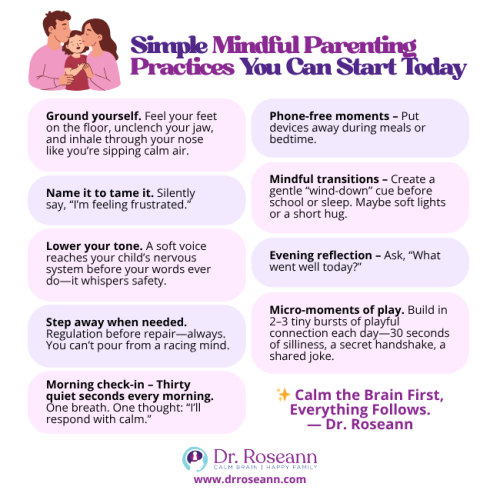
Mindfulness works best when it’s part of real life—not just something we pull out during chaos. Think of it like steady breathing through waves instead of waiting until you’re underwater to learn how to swim. Calm the brain first, everything follows.
Everyday mindful habits:
- Morning check-in – Thirty quiet seconds. One breath. One thought: “I’ll respond with calm.” It sets the tone for the whole day.
- Phone-free moments – Put devices away during meals or bedtime. Presence becomes a soft kind of magic that rewires connection.
- Mindful transitions – Create a gentle “wind-down” cue before school or sleep. Maybe soft lights or a short hug—signals that say, we’re shifting gears now.
- Evening reflection – Ask, “What went well today?” Small wins anchor hope far better than dwelling on mistakes.
- Micro-moments of play. Build in 2–3 tiny bursts of playful connection each day—30 seconds of silliness, a secret handshake, a shared joke.
Tiny rituals like these whisper safety into your child’s nervous system. They build rhythm, predictability, and warmth—exactly what a dysregulated brain craves. Over time, they don’t just calm your child; they calm you too (Coatsworth et al., 2018).
How Does Mindful Parenting Improve Attention and Focus?
When kids feel emotionally safe, the brain’s prefrontal cortex—the part responsible for attention, reasoning, and self-control—finally comes online. But when stress takes over, the brain gets stuck in survival mode, making it almost impossible to focus, learn, or listen.
Mindful parenting helps by:
- Reducing background stress that hijacks attention
- Modeling sustained focus and presence
- Encouraging movement and sensory breaks that regulate the nervous system
Parent Tip:
Create a “focus zone” at home with soft lighting, minimal clutter, and a few sensory tools that help your child’s brain feel grounded and safe.
“Your brain is wired to keep you alive, not necessarily happy.”
— Dr. Andrew Huberman, neuroscientist, Stanford University

It’s normal for kids—especially those with ADHD, anxiety, or autism—to resist new routines at first. Their nervous system may not trust the calm yet.
What to do:
- Keep sessions short (1–3 minutes)
- Make it playful (try mindfulness walks or sensory games)
- Co-regulate—model calm instead of instructing it
- Celebrate micro-moments of progress
Parent Story:
When Ben, age 7, refused to sit still for breathing exercises, his mom turned it into a “dragon breath” game. He loved pretending to blow fire—and within weeks, his emotional control improved.
Takeaway:
Playfulness opens the door to mindfulness.
How Mindful Parenting Supports Children with ADHD, Anxiety, or Dysregulation
Mindful parenting helps neurodivergent kids feel seen instead of judged. When parents shift from managing behavior to calming dysregulation, connection begins to bloom. You stop fighting fires and start understanding where the flames come from.
That’s how healing begins—when you calm the brain first, everything follows.
- For ADHD – Use mindful movement and sensory breaks to release energy
- For anxiety – Pair grounding techniques with compassionate reassurance
- For mood swings or OCD – Create predictable routines and reduce sensory overload
Remember:
It’s not bad behavior. It’s a dysregulated brain asking for help.
How To Practice Mindful Parenting When You’re Exhausted or Overwhelmed
Parent burnout is real. You can’t pour from an empty cup—or regulate a child when your own brain is on fire.
Try these parent-care micro-regulation habits:
- Two minutes of breathing before pickup or bedtime
- A short walk outside without your phone
- A calming scent or song that signals relaxation
- Permission to pause: it’s okay to reset
Parent Story:
After months of sleepless nights, Maria began a nightly “quiet minute.” Just sixty seconds of stillness before bed helped her nervous system reset—and her patience grew tenfold.
How Families Can Make Mindfulness a Shared Practice
Mindfulness becomes a living, breathing thing when everyone joins the rhythm. Families that regulate together—grow together.
Try this:
- Start “gratitude dinners” where everyone shares one joy from the day.
- Create a calm-down corner with cozy textures, breathing cards, and coloring tools.
- End the day with a simple family mantra: “We calm our brains together.”
Remember:
Consistency—not perfection—creates lasting change.
That’s how families heal. That’s how we unlock potential hiding beneath dysregulation. Behavior isn’t brokenness—it’s a message from an overwhelmed nervous system saying, “Please help me feel safe.”
Calm the brain first, everything follows.
Parent Action Steps
- Start each morning with one deep breath and an intention.
- Create phone-free zones during meals and bedtime.
- Use calming cues before transitions like school or sleep.
- End the day with a gratitude or “what went well” check-in.
- Practice presence—listen without rushing to fix.
FAQs
What age can I start mindful parenting with my child?
Any age. Even babies sense your calm. Toddlers learn through your modeling, and teens thrive when mindfulness feels like care, not control.
Does mindfulness replace therapy or medication?
No. It complements them beautifully. A calmer nervous system helps other supports—like therapy or medication—work more effectively.
What if I’m not a “calm” person by nature?
That’s okay. Calm grows with practice. Mindfulness isn’t about perfection—it’s about noticing and returning to presence again and again.
How long before I see changes?
You may notice softer moments—more connection, fewer power struggles—within weeks of consistent practice. Small shifts lead to lasting change.
Can mindfulness help with school behavior?
Yes. When a child’s brain feels safe and regulated, focus improves, directions stick, and learning becomes easier. Calm brains learn best.
Citations
Bornstein, M. H., & Esposito, G. (2023). Coregulation: A Multilevel Approach via Biology and Behavior. Children (Basel, Switzerland), 10(8), 1323. https://doi.org/10.3390/children10081323
Coatsworth, J. D., Timpe, Z., Nix, R. L., Duncan, L. G., & Greenberg, M. T. (2018). Changes in Mindful Parenting: Associations With Changes in Parenting, Parent-Youth Relationship Quality, and Youth Behavior. Journal of the Society for Social Work and Research, 9(4), 511–529. https://doi.org/10.1086/701148
Huberman, A. D. (2021, February 8). How to focus to change your brain [Audio podcast episode]. In Huberman Lab. https://www.hubermanlab.com/episode/how-to-focus-to-change-your-brain
Townshend, K., & Caltabiano, N. J. (2019). The extended nervous system: affect regulation, somatic and social change processes associated with mindful parenting. BMC Psychology, 7(1). https://doi.org/10.1186/s40359-019-0313-0
Dr. Roseann is a mental health expert in Neurodivergence who is frequently in the media:
- CBS (Video) Student Learning Resources Quarantine
- CT FOX61 (Video) Homeschooling Tips During Quarantine
- Parents 5 Creative Ways Parents Are Finding Child Care During the Pandemic
Always remember… “Calm Brain, Happy Family™”
Disclaimer: This article is not intended to give health advice and it is recommended to consult with a physician before beginning any new wellness regime. *The effectiveness of diagnosis and treatment vary by patient and condition. Dr. Roseann Capanna-Hodge, LLC does not guarantee certain results.
Are you looking for SOLUTIONS for your struggling child or teen?
Dr. Roseann and her team are all about science-backed solutions, so you are in the right place!