
Estimated reading time: 8 minutes
If you’re a teacher supporting a student with ADHD, anxiety, dyslexia, or another learning difference, you know how hard it can be to meet every child’s needs and keep the day running smoothly.
A 504 plan isn’t just paperwork—it’s a roadmap that helps you teach with confidence and compassion.
Read about: Special Education for Dysregulated Kids
It’s also not about red tape; it’s about giving every child access to learning in a way their brain can handle. When used well, a 504 plan turns “I can’t do this” moments into “I can—with the right support.
What Is a 504 Plan?
A 504 plan is a legal document under Section 504 of the Rehabilitation Act of 1973 that ensures students with physical or mental impairments—those that substantially limit major life activities like learning, focusing, or socializing—have equal access to education.
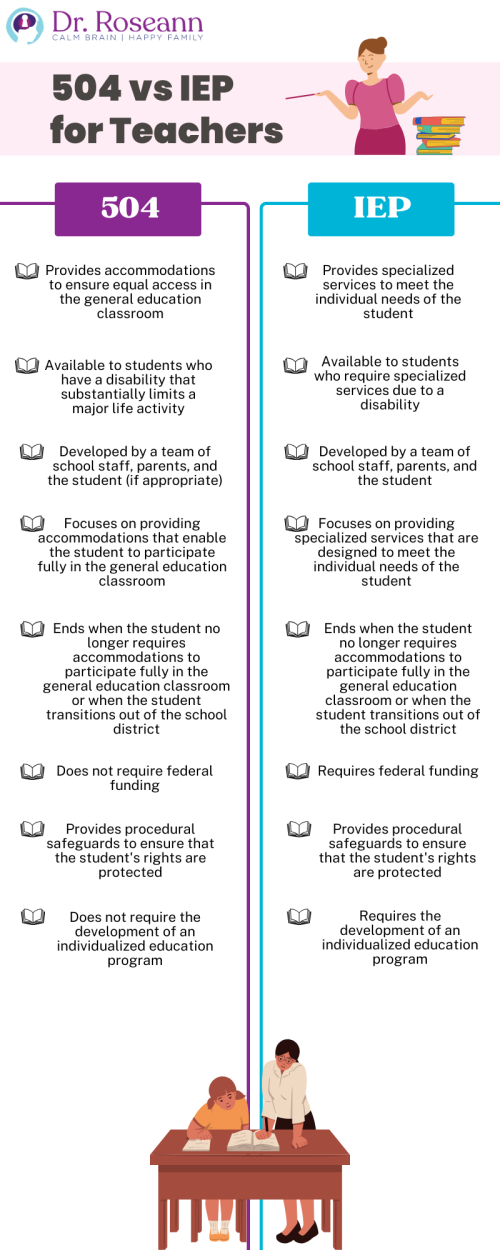
Unlike an IEP (Individualized Education Program), which provides specialized instruction, a 504 plan focuses on accommodations that allow students to learn effectively within the general education setting. It’s about access, equity, and setting up both you and your students for success.
Examples of accommodations may include:
- Preferential seating to reduce distractions
- Extended time on tests and assignments
- Modified homework load
- Breaks for regulation or movement
- Assistive technology (e.g., speech-to-text)
When implemented thoughtfully, a 504 plan can be a teacher’s ally — not a burden — helping you manage behaviors, prevent meltdowns, and support academic success.
“Section 504 … is designed to meet the individual educational needs of students with disabilities, including ADHD,” notes Dr. Jeffrey Katz, PhD, psychologist and education consultant for CHADD.
His reminder underscores that each 504 plan must reflect a student’s unique brain and learning profile, not a template pulled from a binder.
How Is a 504 Plan Different from an IEP?
Both 504 plans and IEPs are designed to support students with disabilities, but they differ in scope and process.
- IEPs provide specialized instruction, measurable goals, and often related services (like speech or occupational therapy).
- 504 plans provide access through accommodations — not special education.
Think of it this way:
A 504 plan removes barriers.
An IEP changes the path entirely.
As a teacher, your main responsibility under a 504 plan is to apply accommodations consistently. You don’t have to rewrite lessons — you simply adapt delivery so the student’s brain has the support it needs to engage and learn.
Who Qualifies for a 504 Plan?
Any student with a physical or mental impairment that substantially limits one or more major life activities may qualify.
These include:
- ADHD or executive-function challenges
- Anxiety or mood disorders
- Autism Spectrum Disorder (ASD)
Chronic medical conditions (asthma, diabetes, epilepsy)
- Traumatic brain injury or concussion recovery
Eligibility isn’t based on diagnosis alone — it’s about impact on functioning in the classroom. If a student’s condition affects focus, attendance, task completion, or emotional regulation, they may need a 504 plan.
What Is the Teacher’s Role in a 504 Plan?
Your role is crucial. You’re the one who sees how the student learns, reacts, and participates day to day. Teachers are often the bridge between what’s written in the plan and what actually works in practice.
Here’s how you can make that bridge strong:
- Understand the accommodations listed in the plan — not just what to do, but why it helps the brain.
- Communicate early and often with parents and the 504 coordinator.
- Track what works. Keep quick notes on when a student succeeds or struggles.
- Adjust classroom supports within the spirit of the plan.
💡 Example:
I once worked with a teacher, Ms. Lopez, whose fourth grader froze every time it was their turn to read aloud. Instead of pushing through, she let the student record their part the night before. That small, compassionate shift kept the 504 plan intact—and the child’s confidence bloomed almost overnight.
Recent research mirrors what I hear from so many teachers. In one California district, educators shared that while they understood how important their role was in implementing 504 plans, many still felt unsure or under-supported (Murray, 2023).
It’s a powerful reminder that teachers don’t need more pressure—they need more clarity, collaboration, and compassion from their school teams.
How Can Teachers Help Students Thrive Under a 504 Plan?
The most effective teachers don’t see accommodations as “extra work” — they see them as tools for brain regulation and access.
Here are some actionable strategies:
- Build routines. Predictability calms the nervous system and reduces avoidance behaviors.
- Offer movement breaks. Short resets (two minutes of wall pushes or deep breathing) can prevent escalation.
- Use visual aids and timers. They support executive-function skills and ease transitions.
- Simplify directions. One-step instructions reduce cognitive load.
- Practice co-regulation. A calm tone and steady presence help dysregulated brains mirror safety.
These micro-shifts take seconds but can transform the classroom climate for everyone — not just the student with a plan.
A 2025 survey found that nearly 6 in 10 teachers had “never” or only “sometimes” received training on Section 504 (Burke, 2025). That gap says so much—not about teachers’ dedication, but about how much support and professional development we still need to give them to feel confident in meeting every child’s needs.

How Is a 504 Plan Created?
The process starts when a parent, teacher, or counselor notices that a student is struggling in ways tied to a medical or psychological condition.
The steps typically include:
- Referral: Anyone — teacher, counselor, or parent — can request an evaluation.
- Data collection: Teachers provide classroom data, work samples, and observations.
- Eligibility meeting: A team reviews whether the student’s challenges substantially limit learning or another major life activity.
- Plan development: Together, the team lists accommodations that address specific needs.
- Implementation and review: Teachers apply the plan, and the team revisits it at least annually.
Remember: you are not expected to diagnose — your observations guide the team toward understanding how a student’s brain is functioning in the classroom.
What Happens When a 504 Plan Isn’t Working?
Sometimes, even with a plan, a student continues to struggle. This doesn’t mean the plan failed — it means the brain needs a different kind of support.
If you notice ongoing issues, such as:
- Persistent avoidance or meltdowns
- Worsening anxiety or frustration
- Accommodations not being effective
Bring your observations to the 504 team. Together, you can revise the plan — or consider whether an IEP evaluation might be more appropriate.
“Behavior is communication,” as I always remind parents and teachers. When a student resists, withdraws, or acts out, it’s not defiance — it’s dysregulation.
How to Collaborate With Families on 504 Plans
The most successful 504s come from open, respectful communication between teachers and parents.
Try these strategies:
- Start positive. Lead with the child’s strengths before discussing challenges.
- Share specific observations. “I’ve noticed she focuses better with visual timers.”
- Ask for insight. Parents often know what regulation strategies work at home.
- Keep updates simple but consistent. Quick emails go a long way.
💬 Example:
“We’re using ‘Regulate → Connect → Correct™’ in class by adding a short movement break before writing. It’s helping him transition more smoothly — wanted you to know!”
This kind of note builds trust and reminds parents that their child is understood, not judged.
Research backs up what I’ve seen time and again—families who felt supported in their 504 journey almost always mentioned one thing: a caring, responsive teacher (Lindsay et al., 2025). When collaboration and follow-through are strong, everyone wins.
As education-law expert Dr. Perry Zirkel reminds us, “There’s a big difference between what the lore is and what the law is.” That’s why clarity and communication matter just as much as compassion when it comes to implementing a 504 plan.
Supporting Yourself While Supporting Students
Teaching students with diverse needs is meaningful but emotionally demanding. Remember: regulating your own nervous system helps your students regulate theirs.
- Take mini breathing breaks between classes.
- Set realistic expectations — progress, not perfection.
- Celebrate small wins.
When you stay calm, you lend your calm to a dysregulated child.
Final Thoughts
A 504 plan for teachers isn’t about paperwork — it’s about partnership. You are one of the most influential factors in helping a student feel safe, seen, and capable.
Keep connecting, collaborating, and remembering that behavior is communication. When you respond with empathy and structure, you not only meet legal requirements — you help a child’s brain learn how to calm and focus.
Grab my Ultimate Guide to 504 Accommodations to see practical examples of supports for attention, memory, anxiety, behavior, and more.
FAQs
What is the teacher’s responsibility in a 504 plan?
Teachers must apply the listed accommodations and monitor the student’s progress. Small, consistent adjustments help ensure equal access to learning.
Can a teacher request a 504 plan for a student?
Yes. If you notice ongoing struggles tied to attention, learning, or health, you can refer the student for a 504 evaluation.
How is a 504 plan different from an IEP?
A 504 plan provides classroom accommodations for access, while an IEP adds specialized instruction and individualized goals.
What are common 504 accommodations?
Examples include extra time, movement breaks, preferential seating, and visual supports—all simple ways to reduce stress and boost focus.
What should teachers do if a 504 plan isn’t being followed?
Because a 504 plan is legally binding, report concerns to your 504 coordinator or administrator right away to adjust or clarify implementation
Citations
Burke, M. M., Mercer, C., Ramos-Torres, S., Lindsay, R., & Burakov, I. (2024). Frequently asked questions and answers for supporting Section 504 implementation among school personnel. Intervention in School and Clinic, 60(4):214-219. https://doi.org/10.1177/10534512241297322
Lindsay, R. A., et al. (2025). Exploring Family Experiences With Section 504 Plans for Their Autistic Children. J Autism Dev Disord. https://doi.org/10.1007/s10803-025-06856-2
Murray, A. R. (2023). Teachers’ attitudes, capacity, and preparation in implementing Section 504 plans in one California school district [Doctoral dissertation, California State University, Sacramento]. CSUS ScholarWorks. https://scholars.csus.edu/esploro/outputs/doctoral/99257831027701671
Dr. Roseann is a mental health expert in Self-Regulation who frequently is in the media:
- Healthline Understanding Self-Regulation Skills
- Scary Mommy What Is Self-Regulation In Children, And How Can You Help Improve It?
- HomeschoolOT Therapy Services Understanding Nervous System Dysregulation in Children: A Guide for Homeschool Parents
Always remember… “Calm Brain, Happy Family™”
Disclaimer: This article is not intended to provide health advice. It is recommended to consult with a physician before beginning any new wellness program. The effectiveness of diagnosis and treatment varies by patient and condition. Dr. Roseann Capanna-Hodge, LLC does not guarantee specific results.
Are you looking for SOLUTIONS for your struggling child or teen?
Dr. Roseann and her team are all about science-backed solutions—so you are in the right place!
©Roseann Capanna-Hodge