Estimated reading time: 8 minutes
For many parents of children with learning, behavioral, or emotional differences, traditional school can feel like a daily struggle of stress, meltdowns, and constant advocacy.
Homeschooling special needs children offers something different: a chance to slow down, individualize learning, and bring peace back into your child’s day. But it can also feel overwhelming to know where to start.
In this guide, you’ll discover four essential steps to homeschooling a child with special needs, including:
- Expert insights from homeschooling advocate Terrie McKee of IAJ Ministries
- The latest research on how individualized, flexible teaching supports learning and regulation
- Practical, brain-based strategies I use in my own work to help neurodivergent kids calm their nervous systems and thrive
What Does Homeschooling Mean for a Neurodivergent Child?
Homeschooling special needs children means you, the parent, become your child’s primary teacher, guiding learning right at home instead of relying on a traditional classroom.
For neurodivergent learners—kids with ADHD, autism (ASD), dyslexia, anxiety, or other learning and behavioral differences—this shift can be truly transformative.
Traditional School vs. Homeschooling for Neurodivergent Kids
| Traditional School | Homeschooling for Neurodivergent Kids |
| Fixed schedules, long school days | Flexible routines and customized pacing |
| High sensory load (noise, crowds, lights) | Calmer, sensory-friendly environment |
| One-size-fits-all curriculum | Personalized, interest-based learning |
| Focus on grades and standardized tests | Focus on mastery, self-regulation, and growth |
| Limited movement and emotional support | Frequent breaks, co-regulation, and parent connection |
Why homeschooling benefits neurodivergent children
- Flexible pacing: You can slow down or speed up depending on your child’s focus and mood.
- Sensory control: Choose calm spaces, lighting, and sound levels that help your child stay regulated.
- Individualized learning: Tailor materials to your child’s strengths and interests—no one-size-fits-all worksheets.
- Confidence through success: Each small win builds mastery and motivation instead of frustration.
- Emotional safety: Home becomes a secure environment where the nervous system can calm and learn.
Research backs this up:
A 2024 meta-analysis found that homeschooling significantly improves learning motivation and engagement when teaching is flexible, personalized, and centered on the child’s interests (Eldeeb, 2024).
When kids feel safe, calm, and understood, their brains can finally relax enough to learn—and that’s where growth happens.
Dr. Brian Ray, homeschooling researcher and founder of the National Home Education Research Institute, explains:
“Parents of children with additional needs are increasingly choosing homeschooling because they believe the traditional school environment cannot adequately meet their child’s unique learning and regulatory profile.”
His findings underscore a key truth: when education is emotionally safe, brain-based, and responsive, children not only learn better—they thrive.
Key Takeaway:
When education adapts to your child’s nervous system instead of forcing them to adapt to the system, learning becomes calmer, deeper, and far more joyful.
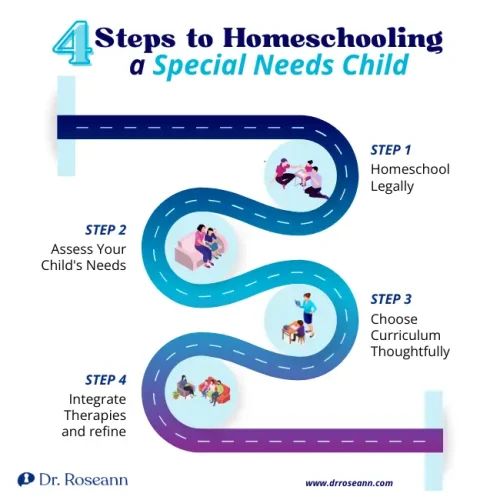
STEP 1: How To Legally Start Homeschooling a Special Needs Child
Every state has its own homeschooling laws.
Terrie McKee reminds parents that the first step is to do it legally—and to keep proper records.
Check your state’s requirements at HSLDA.org for notices of intent, attendance tracking, or required subjects.
Quick checklist for legal homeschooling:
✅ Submit your Notice of Intent to Homeschool (if required)
✅ Keep attendance and progress records
✅ Maintain documentation of assessments and therapies
✅ Review state testing or portfolio requirements
STEP 2: How To Assess Your Child’s Unique Learning and Regulation Needs
Before buying a single curriculum book, pause to understand where your child is academically and emotionally.
Terrie McKee emphasizes using placement testing or evaluations to discover the right starting point—not the grade printed on a school form.
But I always remind parents: It’s not just about academics—it’s about regulation. Your child’s brain can’t learn if it’s dysregulated.
Professor Janice Wearmouth, a special-education expert, reminds us:
“What matters most is not replicating a classroom environment at home but creating an environment in which the dysregulated brain can first calm, then learn.”
This reinforces why emotional regulation—not just academics—should shape your homeschool rhythm.
Consider both academic and nervous-system factors:
- Reading, writing, and math placement levels
- Sensory sensitivities (sound, light, texture)
- Executive-functioning strengths and struggles
- Emotional regulation and triggers
- Energy cycles—when your child is most focused and calm
A 2024 study of homeschooling families—including those raising children with learning or behavioral differences—found that most parents naturally adapt lessons around their child’s sensory, therapeutic, and emotional rhythms (Forlin, 2024).
That kind of flexibility isn’t just practical—it’s healing. When we honor a child’s nervous system instead of fighting against it, we create the safety their brain needs to learn and flourish.
Parent Story:
Nancy, mom of a 10-year-old with dyslexia and anxiety, shared that her son “finally exhaled” when learning at home. By starting math lessons after breakfast instead of first thing in the morning, his focus improved dramatically. “I realized timing was everything—not just content,” she said.

This is where most parents get stuck—there’s no one perfect curriculum.
Look for curricula that are flexible, multi-sensory, and mastery-based rather than rigid or test-heavy.
Key features of a neurodiversity-friendly curriculum:
- Visual, auditory, and kinesthetic learning options
- Short, structured lessons (10–20 minutes per subject)
- Frequent breaks and movement opportunities
- Real-world application (baking for math, gardening for science)
- Built-in self-regulation moments (breathing, fidgets, calming tools)
Dr. Donald Deshler, an expert in learning disabilities and inclusive education, notes:
“Success for learners with special needs hinges on one-to-one teaching, scaffolded support, and frequent self-regulation breaks—not a one-size-fits-all curriculum.”
That’s exactly the spirit of homeschooling—meeting your child where they are.
Research also shows that motivation and engagement rise sharply when children learn through hands-on, interest-based activities (Eldeeb, 2024).
STEP 4: How To Integrate Therapies and Emotional Regulation into Homeschooling
Many special-needs children rely on occupational, speech, or behavioral therapies—and those can fit beautifully into your homeschool schedule.
Terrie McKee advises, “Make therapy part of school, not something extra.”
That means counting OT or speech sessions as part of learning time rather than after-school work.
Tips for integrating therapy into homeschool life:
- Schedule therapies at times of optimal focus
- Use therapy exercises as part of physical education or life skills
- Keep communication open with your therapists—they’re part of your homeschool team
- Remember, emotional regulation is a learning goal
“Let’s calm the brain first—because a calm brain is a learning brain.” — Dr. Roseann
How To Keep Your Sanity While Homeschooling a Special Needs Child
Even the most patient parents hit walls. Homeschooling is a marathon, not a sprint.
Give yourself grace, and remember: you’re not replicating school—you’re re-imagining it.
Strategies to stay balanced:
- Set gentle expectations: Progress is progress, no matter how small.
- Build community: Join special-needs homeschool groups.
- Schedule self-care: Your nervous system matters too!
- Celebrate wins: Write them down—they’ll remind you why you started.
A 2024 analysis of parent practices showed that families who set realistic expectations and embraced flexibility reported higher satisfaction and lower stress (Forlin, 2024).
When you build rest and reflection into your week, you support both your child’s regulation—and your own.
Next Steps
Homeschooling special-needs children isn’t about perfection—it’s about creating an environment where your child feels safe, seen, and successful.
Key takeaways:
- Follow your state’s legal process and keep records
- Understand your child’s academic and emotional needs
- Choose flexible, multi-sensory materials
- Integrate therapies as part of your homeschool rhythm
- Give yourself permission to rest and reset
You’ve got this. When you parent and teach from a place of calm connection, your child’s brain can thrive.
FAQs
Do I need teaching credentials to homeschool my special-needs child?
No. Most states allow parents without licenses to homeschool if they follow state rules. You are your child’s most qualified expert.
Can my child still receive special education services while homeschooled?
Yes, in some states and districts. Check with your local school district or DOE.
How many hours should homeschooling take each day?
For elementary ages, 2–4 hours is typical; for teens, 4–6 hours. Consistency matters more than time.
What if my child refuses to do homeschool work?
Refusal often signals dysregulation. Pause, co-regulate, and return when calm.
What’s the biggest mistake new homeschool parents make?
Trying to copy public school. Home is different—embrace flexibility and progress, not perfection.
Terminology
- Neurodivergent: A person whose brain processes information differently (e.g., ADHD, ASD, dyslexia).
- Regulation: Managing emotions and behaviors in response to stress or stimuli.
- Executive Functioning: Skills that help with focus, planning, and organization.
Citations
Eldeeb, M. K., Diab, T., Alkubish, Y., and Qadhi, S. (2024). Exploring Homeschooling: In-depth Meta-Analysis of Its Impact on Learning Motivation and Factors Influencing Family Choices. International Journal of Learning, Teaching & Educational Research, 3(4). https://doi.org/10.26803/ijlter.23.4.23
Forlin, C. and Chambers, D. (2024). Implementation of Home-Schooling: Parents’ Practices and Perceptions. Educ. Sci., 14(5), 450. https://doi.org/10.3390/educsci1405045
Always remember… “Calm Brain, Happy Family™”
Disclaimer: This article is not intended to give health advice and it is recommended to consult with a physician before beginning any new wellness regime. *The effectiveness of diagnosis and treatment vary by patient and condition. Dr. Roseann Capanna-Hodge, LLC does not guarantee certain results.
Are you looking for SOLUTIONS for your struggling child or teen?
Dr. Roseann and her team are all about science-backed solutions, so you are in the right place!
©Roseann Capanna-Hodge